The Mountain and the Marsh
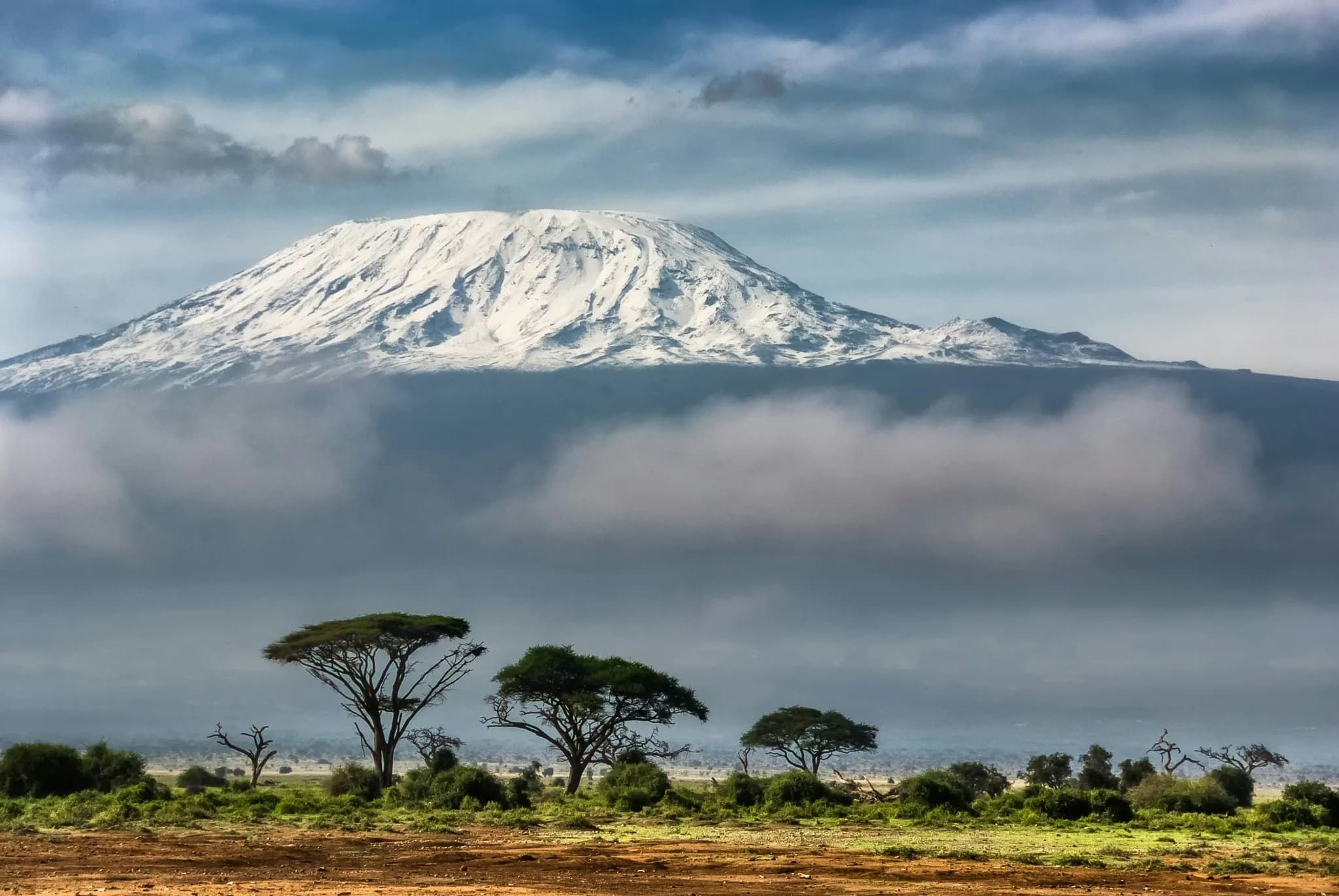
Kilimanjaro is not a subtle presence. At 5,895 metres it is the highest point on the African continent, and it rises out of the plains to the south of Amboseli with a finality that makes every other landmark in the region feel provisional. What is strange, and what almost nobody mentions, is that the mountain is not in Kenya at all — it stands across the border in Tanzania. Amboseli simply has the best seat in the house, and has built its entire reputation on the view.
The park itself is small — some 392 square kilometres, a fraction of the Mara or the Serengeti — and much of it is the bed of a Pleistocene lake that dried out and never came back. In the wet months it floods into shallow water and glare; the rest of the year it is fine alkaline dust that lifts in white sheets behind the vehicles. Amboseli is the Maa word for salty dust, and the name is not decorative.
And yet in the middle of that dust sit swamps that never fail. Rain and snowmelt from Kilimanjaro sink into the volcanic rock of the mountain's flanks, travel underground for decades, and surface here as permanent spring-fed marsh — Enkongo Narok, Longinye and the others, green all year in a landscape that is otherwise bone dry. That single hydrological accident is why Amboseli holds the wildlife it does, why the elephants stay, and why a park this small matters out of all proportion to its size. UNESCO recognised the wider ecosystem as a Biosphere Reserve in 1991.
The Elephants Have Names
Amboseli is the best place in the world to watch elephants, and the reason is not density — several parks hold more. It is knowledge. The elephants here have been studied individually and continuously since 1972, when Cynthia Moss began what is now the longest-running study of wild elephants anywhere on earth. Every animal in the ecosystem is known to the researchers, identified by the notches in its ears and the shape of its tusks, its births, matings and deaths recorded across five decades. Families are catalogued by letter, and each individual carries a name beginning with that letter, so a matriarch's daughters and granddaughters can be read off a single line of the register.
What this does to a game drive is hard to overstate. A guide who has grown up inside that body of knowledge does not point at an elephant. They tell you which family it belongs to, who its mother was, which of the great old bulls fathered the calf at its feet, and what happened to its sister in the drought of a particular year. The animals stop being magnificent scenery and become individuals with documented histories — the rare safari encounter that adds rigour rather than romance.
The bulls are the headline. Amboseli still carries some of the largest-tusked elephants left in Africa, animals whose ivory sweeps almost to the ground — a sight that has effectively vanished from the rest of the continent. It is also a fragile inheritance. The ecosystem straddles the Kenya–Tanzania border and these bulls range far beyond the park's boundary, well outside the protection that the park itself provides, which is the reason the surrounding community land matters as much as the reserve does. Our fuller account of the research and the named herds is in the Tortilis Camp essay.
What Amboseli Is Not
It is worth being direct, because Amboseli is often sold as a complete safari and it is not one. There are no rhino — they were poached out and have not returned. Big cats are present but thin on the ground and hard to find: the terrain is open, the cover is minimal, and anyone whose priority is leopard or a large lion pride will be happier in the Mara. Amboseli is not the Big Five. It is elephants, and a mountain, done better than anywhere else.
The second honest point is pressure. The park is small, close enough to Nairobi to be driven in a long morning, and consequently absorbs a steady flow of day visitors and minibus traffic that concentrates on the same swamp edges and the same sightings. On a busy afternoon at a lion, the vehicles can outnumber the lions considerably. None of this makes Amboseli a poor destination. It makes where you sleep the single most consequential decision of the trip — which is what the next section is about.
The Conservancies Around the Park
The answer to a small, busy park is to stay outside it. Amboseli is ringed by Maasai group ranches that have been progressively set aside as conservancies, and they now hold much of the ecosystem's wildlife along with all of its best land for staying. The elephants move freely between park and community ground on corridors they have used for generations; the vehicles do not. A camp in a conservancy can therefore offer what the national park cannot permit: off-road driving, walking safaris, night drives, a bush breakfast under an acacia with nobody else in sight.
Kimana, to the east, is a 6,000-acre community-owned sanctuary sitting between the park and the Chyulu Hills, on the wildlife corridor toward Tsavo — the Maasai community holds the land, holds equity in the lodge built on it, and fills the roles within it. There are no day-visitor vehicles and no gate queues. On the opposite side, a private conservancy on the park's south-western boundary gives its camp the run of both the reserve and ground that is, in effect, its own. Others — Selenkay to the north among them — work the same model. In every case the arithmetic is the same: the community earns more from the wildlife than from cattle or cultivation, and the corridor stays open.
Where to Stay
Two properties define the top of the market here, and they sit on opposite sides of the park with genuinely different characters.
Tortilis Camp stands on Liimbarishi Hill on the south-western boundary, inside its own private conservancy. The rise lifts it just far enough above the plain to see the mountain whole, framed cleanly to the south and unobstructed, and it is by common agreement the finest Kilimanjaro view of any camp in Amboseli. The register is unshowy: canvas tents with private thatched verandas, family tents with their own pools, a fire pit at the hill's edge that serves as the social centre of the day. Guests can arrange a visit to the elephant research base itself.
Angama Amboseli sits east of the park at 1,400 metres in the Kimana Sanctuary, high enough that the mountain fills the sky rather than the horizon. Its suites were positioned around a single question — where do you put a bed so that Kilimanjaro is the last thing you see at night and the first at dawn — and its architectural gesture is the Mnara, a tower giving a 360-degree view over the sanctuary, the Chyulu Hills and the mountain. It is warm where the same group's Mara lodges are dramatic.
Beyond those two, the conservancies hold a spread of smaller tented camps, and the Chyulu Hills to the east offer a genuinely different landscape — lava fields, cloud forest and horseback riding — for anyone extending the trip. The one arrangement worth avoiding is a large lodge inside the park itself: it puts you in the middle of the traffic rather than outside it.
Practical Considerations
GETTING THERE
Scheduled light aircraft run from Nairobi's Wilson Airport to the Amboseli airstrip in about 45 minutes, followed by a drive of up to 45 minutes to camp; Kimana Airstrip, on the eastern side, is a similar charter hop. International arrivals connect through Jomo Kenyatta. The road from Nairobi takes four to five hours and is worth considering only if you are continuing to Tsavo, which pairs naturally with Amboseli by vehicle along the corridor between them.
IDEAL DURATION
Three nights, and rarely more. Amboseli is small and does one thing extraordinarily well, so two nights risks losing the mountain entirely to cloud while four begins to repeat itself. It is a component rather than a whole trip: three nights here and four in the Mara is one of the strongest weeks in East Africa, and Amboseli also slots cleanly into a longer Kenyan route with Laikipia or onward into Tsavo.
WHEN THE MOUNTAIN SHOWS
Kilimanjaro is shy. For most of the day it wraps itself in cloud and reveals only its lower flanks, then stands clear in the cold hour after sunrise and the still one before sunset — which is why the camps here leave early and time a drive by the mountain as much as by the animals. The dry months, roughly June to October and January to March, give the clearest summits and concentrate the game on the swamps. November's short rains bring dramatic skies and fresh snow on the cap.
WHAT TO PACK
Take the dust seriously — it is fine, alkaline and gets into everything, so bring sealed bags for camera bodies, a blower and cloth rather than a brush, and a buff or scarf for the drives. Neutral colours, a warm layer for the pre-dawn starts, and a long lens: the elephants come close but the mountain does not, and the frame everyone wants needs both in it.
Activities & Excursions
What is available depends entirely on whether your camp sits inside the park or on conservancy land, and everything below is arranged through the camp rather than booked ahead.
THE ELEPHANT RESEARCH BASE
The single excursion that changes the rest of the trip. Sitting with the people who have read these families for half a century turns the names the guides use in the field into records you have seen written down. Numbers are limited and it needs arranging in advance through your camp.
WALKING & NIGHT DRIVES
Neither is permitted inside the national park. Both are available on conservancy land, which is the practical case for staying outside the boundary — a guided walk among the acacias, or a spotlit drive for the nocturnal animals the day never shows you.
OBSERVATION HILL
The one place in the park where you may leave the vehicle and walk: a low volcanic rise with a path to the top and a view over the whole swamp system, the elephant herds moving through it, and the mountain beyond. Best in the last hour of light.
BUSH MEALS
Breakfast laid out beneath an acacia with Kilimanjaro behind it, or sundowners on open ground as the snowfield catches the last of the sun. On conservancy land these can be set anywhere, which is the whole point.
THE MAASAI COMMUNITIES
The conservancy model rests on an agreement with the Maasai who own this land, and the village visits and school programmes run through the camps are exchanges rather than performances. Worth the time on its own terms, and it explains why the corridors are still open.
Further Reading
Both camps in full, and the planning pieces that sit behind the advice above.
Where the Elephants Have Names: Tortilis Camp and the Shadow of Kilimanjaro
On a hill at the south-western edge of Amboseli, in a private conservancy of its own, Tortilis Camp looks out at the highest mountain in Africa — and at elephants its guides can call by name.
7 min readIn the Shadow of the Mountain: Angama Amboseli and Kenya's Most Iconic View
In the Kimana Sanctuary on the slopes of Amboseli, Angama has built a lodge that frames Kilimanjaro from every room. A study in restraint, Maasai culture, and the particular silence that comes with altitude.
6 min read
Ready for the Mountain?
Three nights beneath Kilimanjaro, on conservancy land rather than in the traffic, with the elephants that have been known by name for fifty years. Settle the camp first and let it shape the drives — then search flights and stays to bring it within reach.
Begin Your JourneyProperty information for Tortilis Camp courtesy of The Elewana Collection (@elewanacollection), which retains all rights.