Where the Elephants Have Names: Tortilis Camp and the Shadow of Kilimanjaro
There are mountains you look at, and there is Kilimanjaro. From the south-western edge of Amboseli it does not so much sit on the horizon as preside over it — a snow-capped dome floating above its own haze, so large that the mind refuses it for a moment before agreeing to believe. The plains beneath it are flat and pale, threaded with green swamp fed by the mountain's meltwater, and across them move the animals Amboseli is famous for: some of the largest elephants left on the continent.
Tortilis Camp stands on Liimbarishi Hill, a low rise on that south-western boundary, inside a private conservancy that borders the national park. The position is not incidental. It gives the camp what is, by common agreement, the finest view of Kilimanjaro of any lodge in Amboseli — the mountain framed cleanly to the south, unobstructed, changing colour through the day from blue to gold to the pink of late dusk.
But the view is only half of why people come. The other half walks the swamps below, and the guides here know it by name.
The Mountain
Kilimanjaro is the reason Amboseli exists as a destination, and Tortilis is built to honour it. The hill the camp sits on lifts you just enough above the plain to see the mountain whole, and the camp's days are arranged around it — coffee carried out before dawn, drives that point south into the rising light, sundowners poured as the snowfield catches the last of the sun.
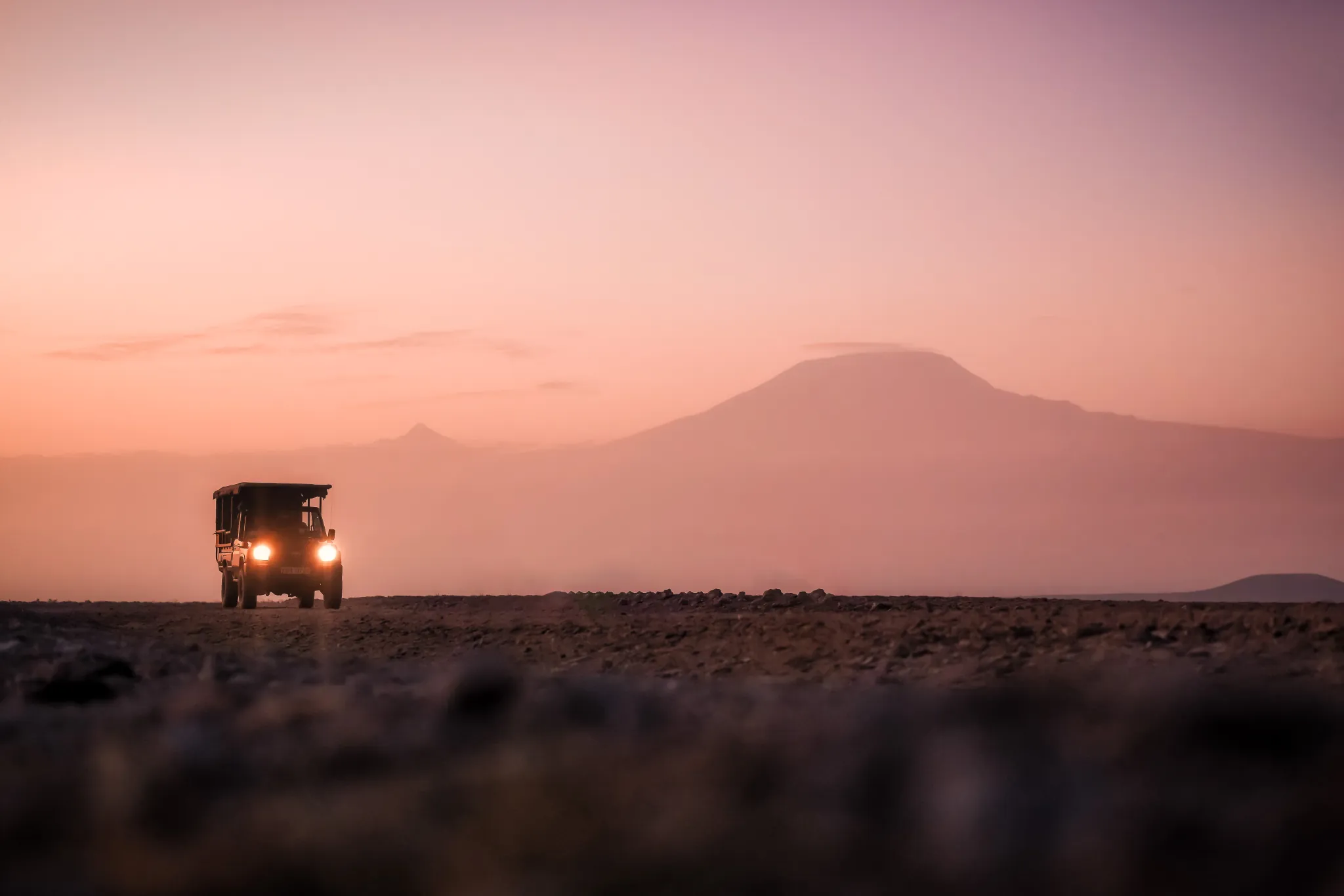 A safari vehicle on the Amboseli plain at dawn beneath Mount Kilimanjaro — Photo: Elewana Collection
The mountain is shy. For much of the day it wraps itself in cloud, revealing only its lower flanks, and then in the clear cold hour after sunrise — or the still one before sunset — it stands clear, the white cap sharp against the sky. Guides here have learned its moods; a morning drive is timed as much by the mountain as by the animals, and the camp's habit of leaving early is rewarded as often by Kilimanjaro as by anything with four legs.
The Hill
Liimbarishi Hill is what makes Tortilis feel like a place apart rather than a camp among others. The rise sets it back from the swamp crowds, gives every tent its outlook, and turns the evening fire into a viewing platform of its own.
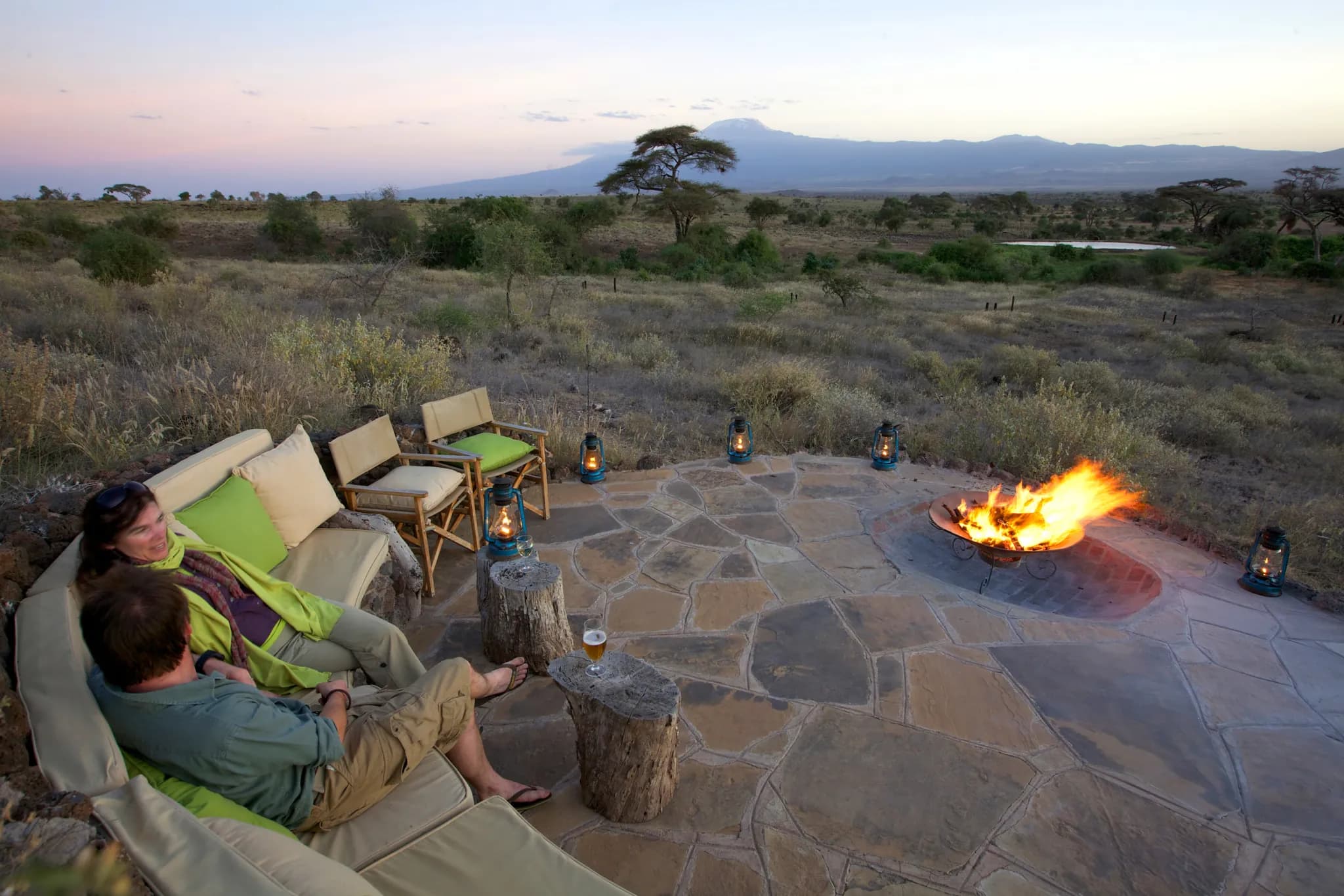 Sundowners by the camp fire on Liimbarishi Hill, Mount Kilimanjaro beyond — Photo: Elewana Collection / Silverless
The fire pit sits at the hill's edge, looking out over the conservancy toward the mountain and a distant waterhole. It is the social heart of the camp in the way the verandah is at Sand River or the boma is in the Mara — the place the day collects itself before dinner. There is no script to it. Lanterns are lit, drinks are poured, and the conversation drifts as the light goes, until Kilimanjaro is a darker shape against a darkening sky.
The Tents
The accommodation is small and unshowy by design: a handful of canvas tents with private verandas, family tents with their own private pool, and a Private House that comes with a pool of its own. Each is angled at the view, and each is built to disappear into the hillside rather than announce itself.
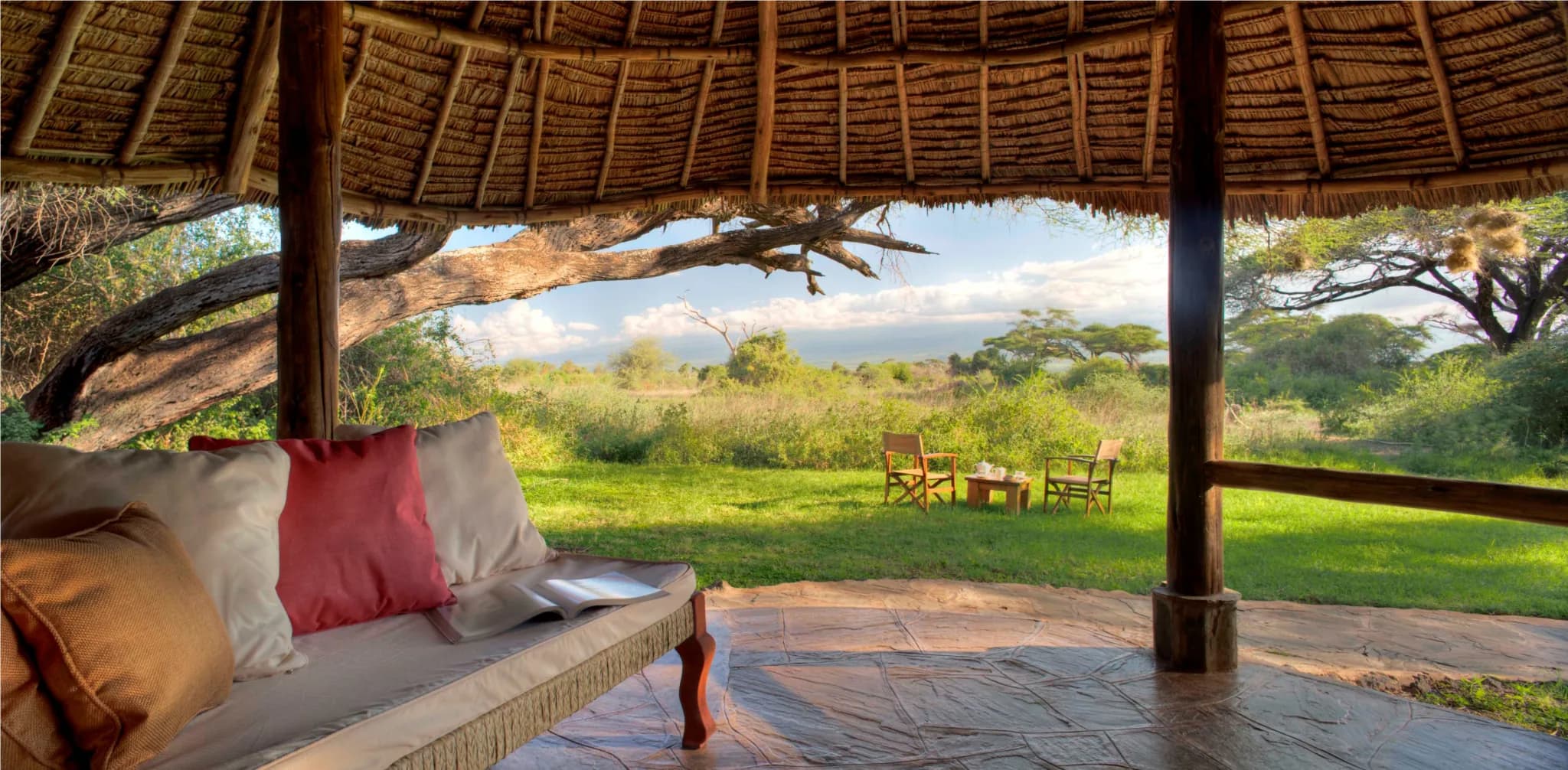 A thatched private veranda at Tortilis Camp, framing the Amboseli bush and an acacia — Photo: Elewana Collection
The veranda is where most of the unscheduled hours of a stay are spent — a daybed under thatch, the bush falling away in front of you, an acacia framing the middle distance. This is the part of Amboseli the photographs rarely capture: not the spectacle of the mountain or the herds, but the long, warm, idle middle of the day, when the plains shimmer and nothing moves and you find you do not want them to.
The Named Herds
Amboseli is the best place in the world to watch elephants, and Tortilis sits in the middle of it. The reason runs deeper than geography. The elephants here have been studied, individually and continuously, for longer than anywhere on earth — and the camp's guides have grown up in that knowledge. They do not point at "an elephant." They tell you which family it belongs to, who its mother was, which of the great old bulls fathered the calves at its feet.
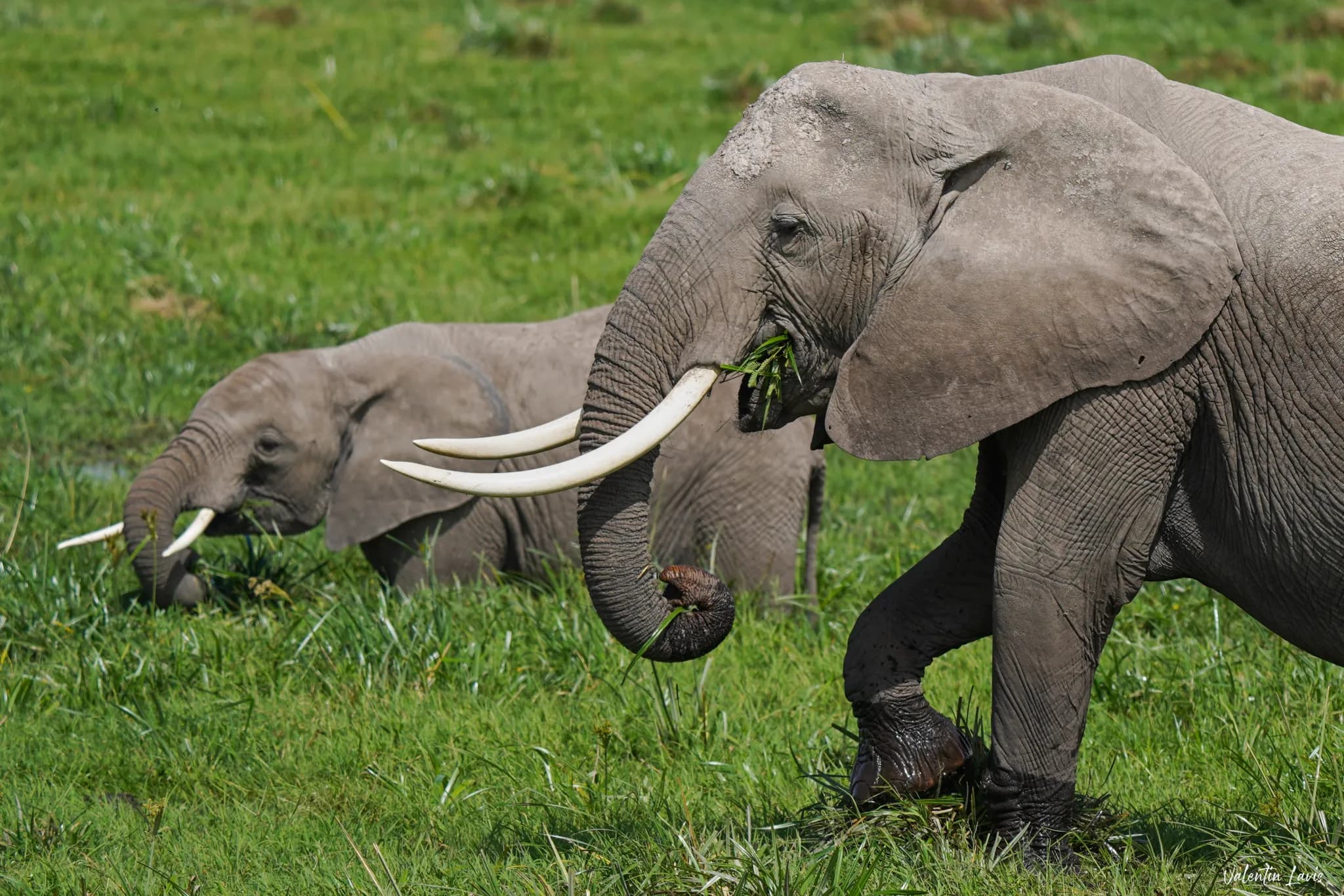 Two large tusked elephants feeding in the Amboseli swamp — Photo: Elewana Collection / Valentin Lavis
The bulls are the headline. Amboseli still carries some of the largest-tusked elephants in Africa — animals whose ivory sweeps almost to the ground, a sight that has all but vanished elsewhere. To watch one feed at close range, the guide quietly naming it and recounting its history, is to understand why this corner of Kenya matters out of all proportion to its size.
Elephants among wildebeest on the Amboseli plain — Photo: Elewana Collection
Cynthia Moss
The names are not folklore. They come from the elephant research project Cynthia Moss founded in Amboseli — the longest-running study of wild elephants anywhere in the world. Every elephant in the ecosystem is known to the researchers, catalogued by the notches in its ears and the shape of its tusks, its births and deaths recorded across decades.
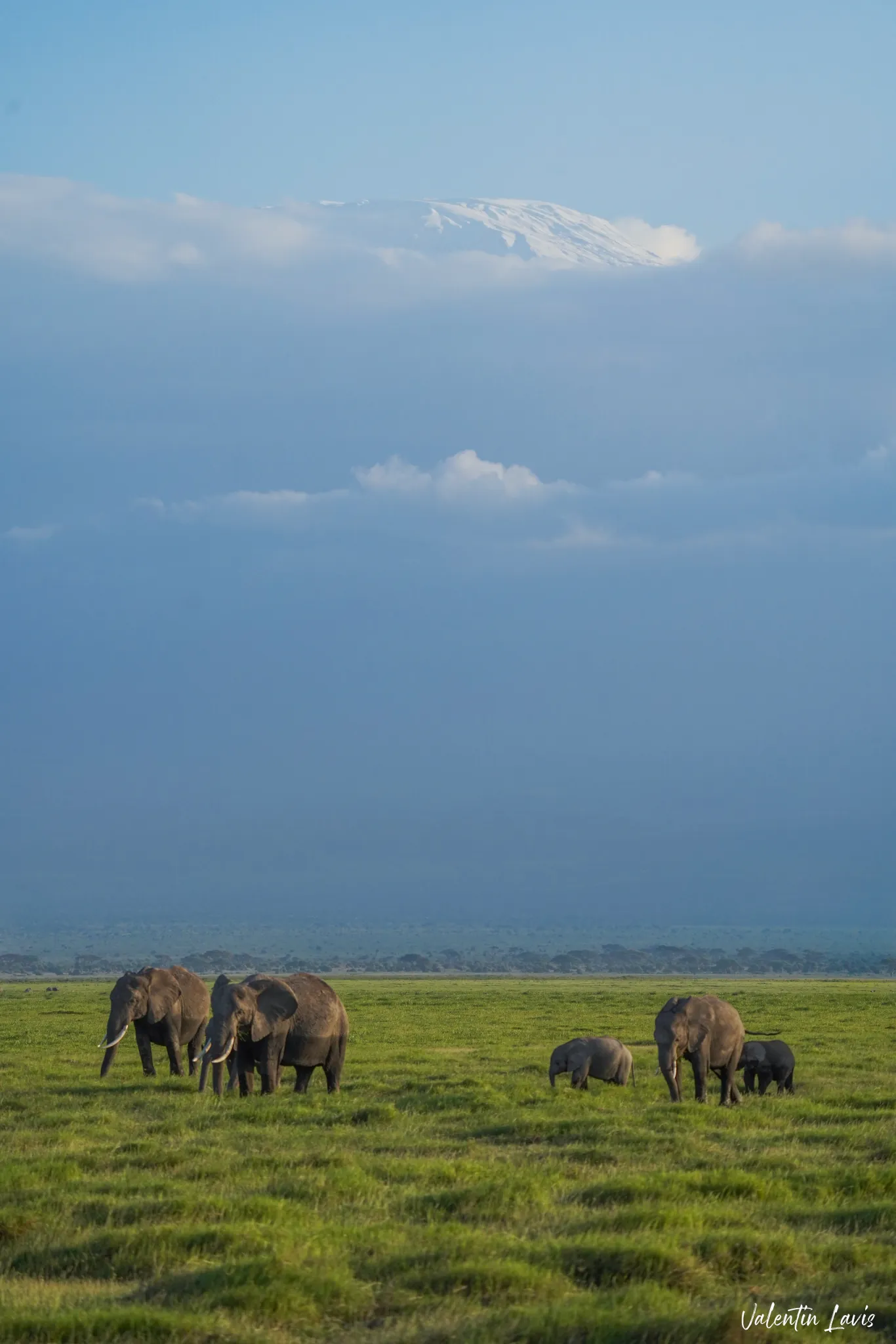 Elephants beneath the snow-capped peak of Mount Kilimanjaro, Amboseli — Photo: Elewana Collection / Valentin Lavis
Tortilis guests can arrange an exclusive visit to the research base — a chance to sit with the people who have spent their lives reading these families, and to understand that the names the guides use in the field are the same ones written in the project's records. It is the rare safari encounter that adds rigour rather than romance: the elephants become not just magnificent but legible, individuals with histories you can follow.
The Conservancy
What lets Tortilis do all of this without the crowding that can afflict Amboseli is that the camp does not depend on the park alone. It sits in a private conservancy on the park's south-western boundary, which means its game drives, bush walks and bush meals can range across both the reserve and ground that is, in effect, the camp's own.
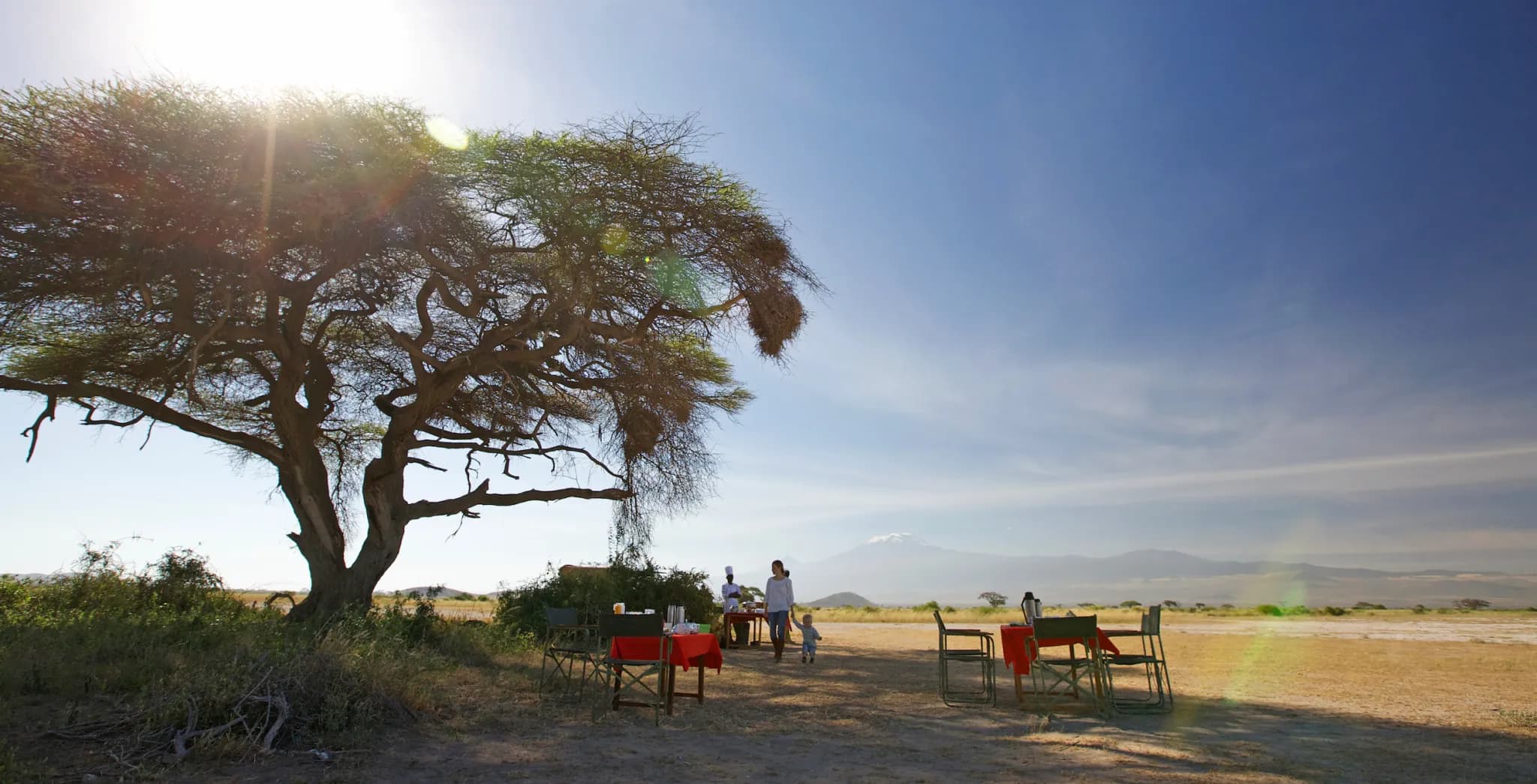 Bush breakfast set beneath an acacia with Mount Kilimanjaro in the distance — Photo: Elewana Collection
The difference is exclusivity. A guided bush walk can take you out on foot, in the park or across the conservancy; a breakfast can be laid out beneath an acacia with the mountain behind and no other vehicle in sight; an evening game drive can run on into a sundowner as the light goes. The conservancy model also underwrites the relationship with the surrounding Maasai community, whose cultural visits and Land & Life school programmes are part of a stay — the same arrangement that keeps the wider ecosystem intact, and keeps the elephants coming.
Getting Here: Tortilis is reached by a 45-minute scheduled flight from Nairobi's Wilson Airport to the Amboseli airstrip, followed by a 45-minute drive to camp. International arrivals connect through Nairobi's Jomo Kenyatta.
When to Visit: Amboseli rewards the dry months — June to October and January to February — when game concentrates on the swamps and Kilimanjaro shows itself most reliably in the clear early light. The mountain is at its most generous at dawn and dusk year-round.
Afrilux9 Verdict: Tortilis is the antidote to the idea that Amboseli is a one-photograph destination. Yes, the Kilimanjaro view from Liimbarishi Hill is the finest in the park — reason enough on its own. But what lingers is the intimacy with the elephants: guides who name them, the world's longest-running elephant research base that you can actually visit, and a private conservancy that lets you walk, eat and linger among them on your own terms. It is a camp for people who want the mountain, and then want to understand what is living in its shadow.
Imagery and property information courtesy of The Elewana Collection (@elewanacollection), which retains all rights.
Cover photograph: Elewana Collection
Part of our guide to Amboseli & Kilimanjaro.
More from Amboseli & Kilimanjaro
Inspired by This Journey?
Search flights and hotels to start planning your own African escape.
Begin Your Journey