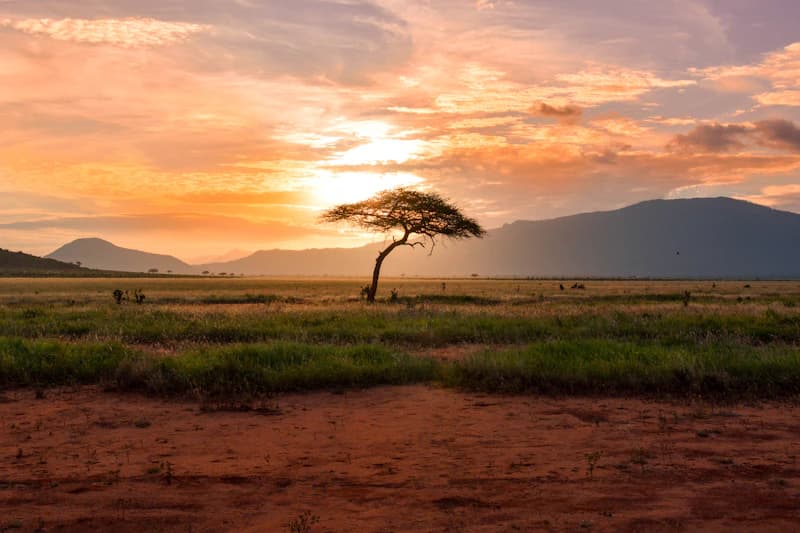
Green Season or Dry Season: When We'd Actually Go
Ask almost anyone when to go on safari and you will get the same two words: dry season. It is the standard answer, it is repeated in every brochure, and it is not wrong. But it is incomplete in a way that costs travellers something — because "go in the dry season" quietly steers you toward the most expensive, most heavily booked, most crowded version of the experience, and presents it as the only sensible choice. I have watched friends pay a premium for August dates, jostle for position at a waterhole, and come home convinced they had seen Africa, never knowing there was another version entirely.
There is. East Africa does not really have four seasons; it has a wet half and a dry half, and the rhythm of rain shapes everything — the grass, the animals, the light, the price, and the number of other vehicles you will share a sighting with. Once you understand that rhythm, "when to go" stops being a single right answer and becomes a genuine choice between two very different, equally legitimate trips. Here is how I weigh them.
What the seasons actually are
Forget summer and winter; near the equator they barely register. What matters is the rain.
The dry season runs, broadly, from late June to October, with a second drier spell over January and February. The land browns off, water sources shrink, and the vegetation thins. The green season — what the industry sometimes calls the "low" or "emerald" season, which tells you more about pricing than about beauty — falls during the long rains of roughly March to May and the short rains of November. The land turns an almost luminous green, the skies fill with cloud and drama, and the crowds thin out along with the prices.
Neither half is "good weather" or "bad weather." They are different countries wearing the same map.
The case for the dry season
The dry season earns its reputation honestly, and for a first safari I usually nod toward it. The logic is simple: as standing water disappears, animals are forced to concentrate around the rivers and waterholes that remain. They are easier to find, easier to predict, and easier to photograph against thin, pale vegetation that hides nothing. If your heart is set on watching a leopard you do not have to work for, or you have a single precious week and cannot gamble it, the dry months stack the odds in your favour.
This is also the season of the headline events — the Mara River crossings I wrote about in our Kenya-versus-Tanzania piece fall squarely within it. And the practical things are easier: roads are firm, mosquitoes fewer, and the daily rhythm uninterrupted by afternoon downpours.
The honest cost is everyone else. The dry season is peak season, which means peak prices — often booked the better part of a year ahead — and the busiest reserves can put a dozen vehicles around a single lion. The very predictability that makes wildlife easy to find makes the experience harder to keep private. You are buying certainty, and certainty is what everyone else is buying too.
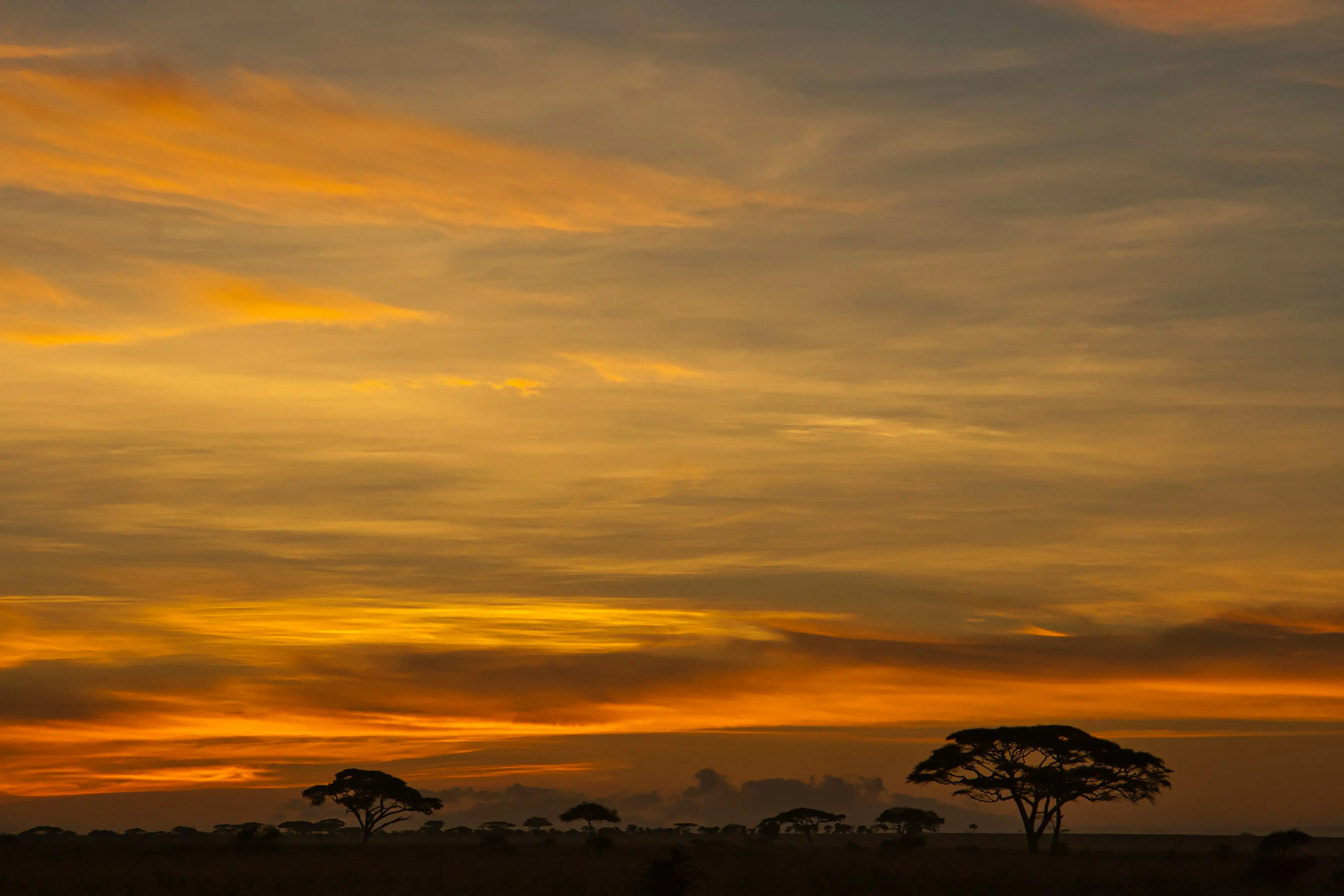 Dawn over the plains in the green months — acacias against a sky the rains have woken up.
The case for the green season
Now the secret. The green season is, to my eye, the more beautiful Africa — and for certain travellers, the better trip outright.
When the rains come, the plains transform. The grass is thick and emerald, the acacias leaf out, the dust is gone, and the light after a storm is the kind photographers travel across the world to chase: low cloud, shafts of sun, skies that actually do something. This is also when the great herbivores give birth. The southern Serengeti calving belongs to this greener half of the year: the short-grass plains green up after the November short rains and stay lush through the wet months, with a relatively drier interlude over January and February — and it is into that brief dry window, on grass made rich by the rains around it, that hundreds of thousands of newborns arrive, with the concentrated predator action that follows. It is birth and drama at once, and it happens when the crowds have gone home.
And the crowds have gone home. This is the quieter, more private Africa — fewer vehicles, the sense of having a wilderness to yourself, and a real chance to feel the scale of the place rather than queue for it. The savings are not marginal either: green-season rates can run substantially below peak, which is often the difference between a lodge being a dream and being a booking. For honeymooners, photographers, returning travellers, and anyone who values solitude over a guaranteed checklist, the green months are not a compromise. They are the point.
It is also the birding season — migrant species arrive, residents come into breeding plumage — which transforms a safari for anyone who looks up as well as out.
The trade-offs are real and I will not soften them. The grass is tall and lush, which means wildlife can be harder to spot and more dispersed, because water is everywhere and the animals are not forced to gather. Rain is genuine — usually dramatic afternoon storms rather than all-day grey, but enough to make a track muddy or an airstrip briefly unusable. The long rains of April and May are the wettest and the gamble is highest; the short rains of November and the shoulder edges of the green season are the sweet spot, offering much of the beauty and saving with less of the risk.
How we'd choose
As with most things in safari planning, the right answer is not universal — it is yours.
If it is your first safari, or you have only one week, or your non-negotiable is the river crossings, go in the dry season, accept the cost and the company, and lean toward private conservancies where vehicle numbers are capped. You will get the certainty you are paying for.
If you are a photographer, a honeymooner, or a returning traveller chasing light, space, and value, go in the green season — and do not let anyone tell you it is second best. The November short rains, in particular, are one of the great underused windows in the safari calendar.
If predators and newborns move you more than the famous crossings, the green season's calving on the southern Serengeti plains is the trip I would book first for myself, every time.
And if you are nervous about rain but seduced by the savings and the solitude, travel the shoulders — the edges of the green season, late in the dry-to-wet transition or the short November rains — where you get much of the emerald beauty and most of the lower prices without committing to the wettest weeks.
A few honest practicalities
Whichever half you choose, build in more days than you think you need; wildlife keeps its own schedule and the single best thing you can buy on safari is time. The green season rewards patience especially — the sightings are there, they are simply more spread out, and a good guide who knows where the animals go when the water is everywhere is worth more in the green months than in any other. Pack for the season honestly: real waterproofs and a willingness to get rained on in the green months; layers for genuinely cold dry-season dawns. And treat any promise of guaranteed sightings, in either season, with the scepticism it deserves. The craft is in choosing the right window for the trip you want, then letting the place be what it is — which, in my experience, is always more than the brochure managed to say.
Our verdict: "Go in the dry season" is safe advice, and for a first trip it is often the right call. But it is not the only Africa, and for a great many travellers it is not even the best one. The green season hands you a greener, emptier, cheaper, more dramatic continent — at the price of a little certainty and the chance of a storm. Decide whether you are travelling for the guaranteed sighting or for the private, luminous, once-the-crowds-have-gone version of the place, and the season will choose itself.
Tell us when you are able to travel and what matters most to you, and we will help you find the window that fits — honestly, and without the brochure gloss.
How We'd Choose
What matters most for when you go?
Inspired by This Journey?
Search flights and hotels to start planning your own African escape.
Begin Your Journey