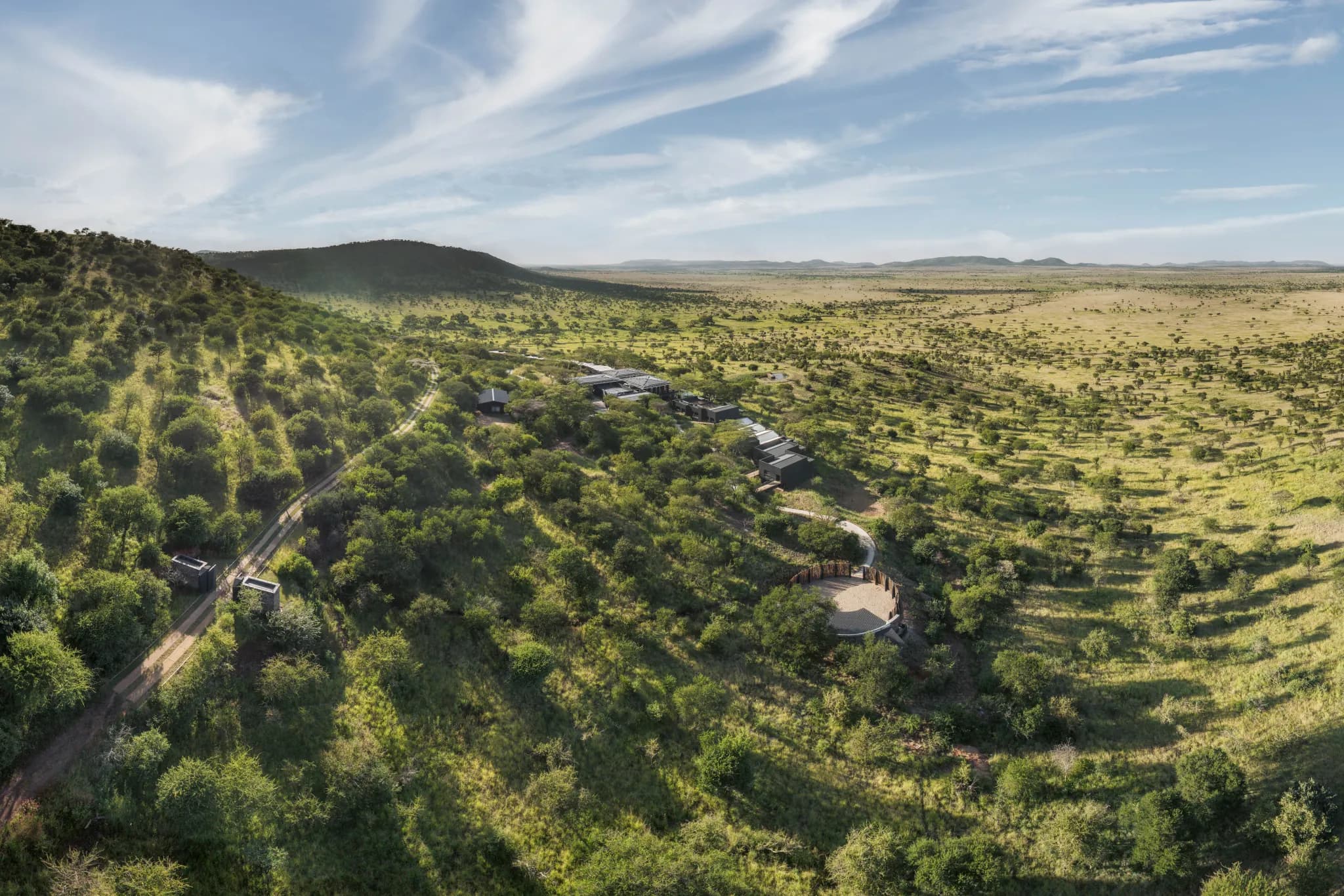
Three Camps, One Migration: Reading the Serengeti by Season
Stand anywhere on these plains and you understand the Serengeti immediately: the grass does not stop, it simply thins into haze, and the horizon is less a line than a rumour. What the eye does not tell you is that the land is moving. The great herds — wildebeest, zebra and gazelle — travel a vast loop through the ecosystem every year, following the rain and the new grass, and the entire spectacle of the Serengeti is really the spectacle of that single, unceasing journey.
This is the difficulty the Serengeti poses to anyone planning a visit. The migration is not in one place. It is a moving target the size of a small country, and a camp that sits in the heart of the action in February may look out over empty plains by July. Most lodges solve this by being where they are and hoping the herds come. Elewana solves it differently — by keeping three camps spread along the migration's annual circuit, each positioned to own a different season of the year.
Choose Pioneer in the south and you arrive for the calving. Choose Migration Camp on the Grumeti and you arrive for the river. Choose Explorer in the central hills and you arrive for the long amphitheatre months when the herds pass directly below. The question is not which camp is best. The question is when you are coming.
The Pilgrimage
To understand the three camps you have to understand the loop they are arranged around. It begins, if a circle can be said to begin, on the short-grass plains of the southern Serengeti, where the herds gather in the green months to give birth. From there they move north and west through the central woodlands, cross the Grumeti, and continue toward the Mara River and the famous crossings of the far north — before the rains turn them south again and the whole pilgrimage repeats.
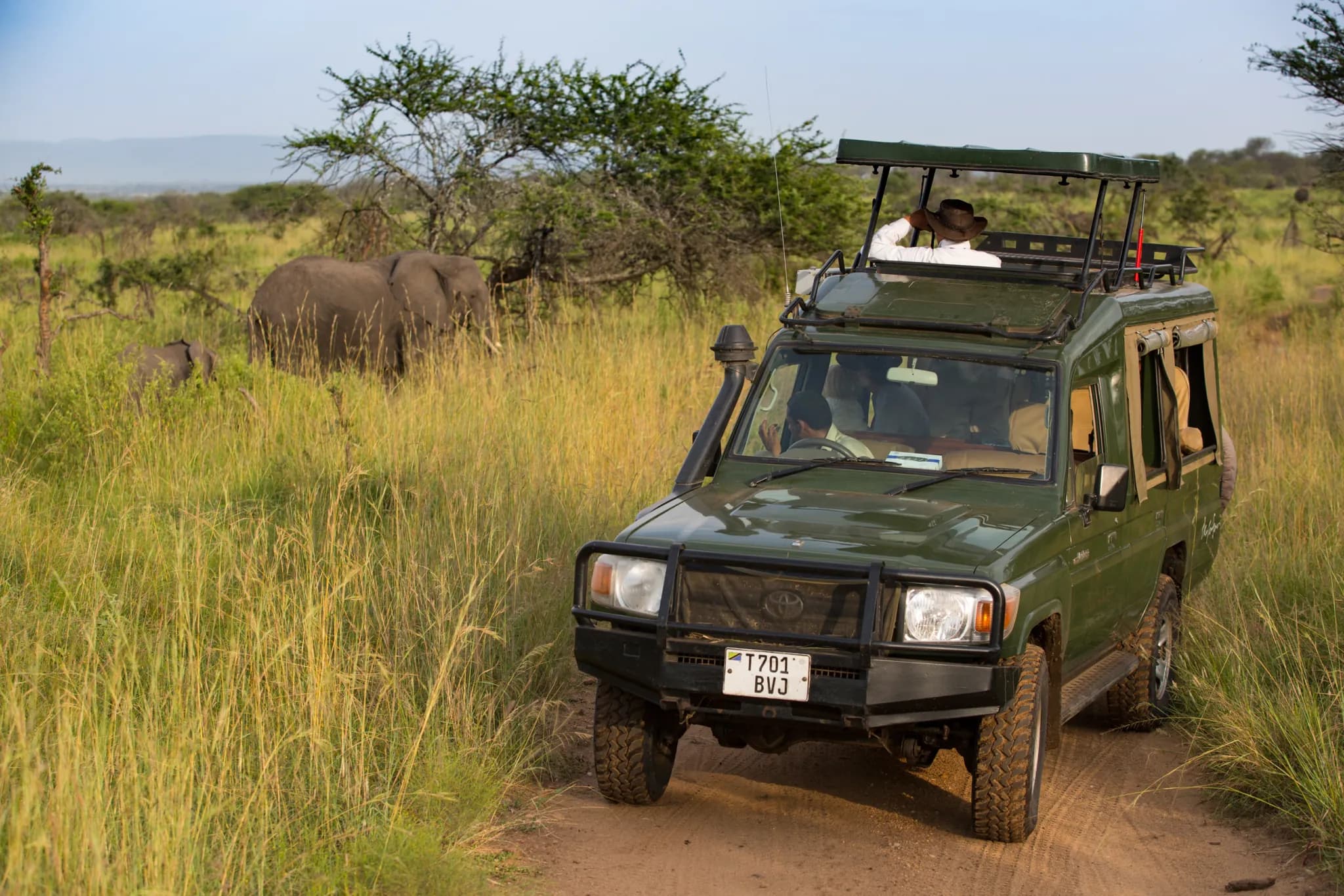 A game drive pauses for elephant on the open Serengeti — Photo: Elewana Collection / Silverless
No fence interrupts it. No road diverts it. The animals have been walking this route for longer than there have been people to watch them, and the Big Five remain present year-round regardless of where the great herds happen to be — so even out of the migration's path, the Serengeti is never empty. But the migration is the headline, and the three Elewana camps read it like three chapters of the same book.
Pioneer: The Calving
Serengeti Pioneer Camp sits on its own kopje in a private corner of the southern Serengeti, near the Moru Kopjes, with the plains sweeping away in every direction. It is the smallest and most classic of the three — canvas tents with private verandahs, rainfall showers and writing desks, the safari of an earlier era preserved without irony.
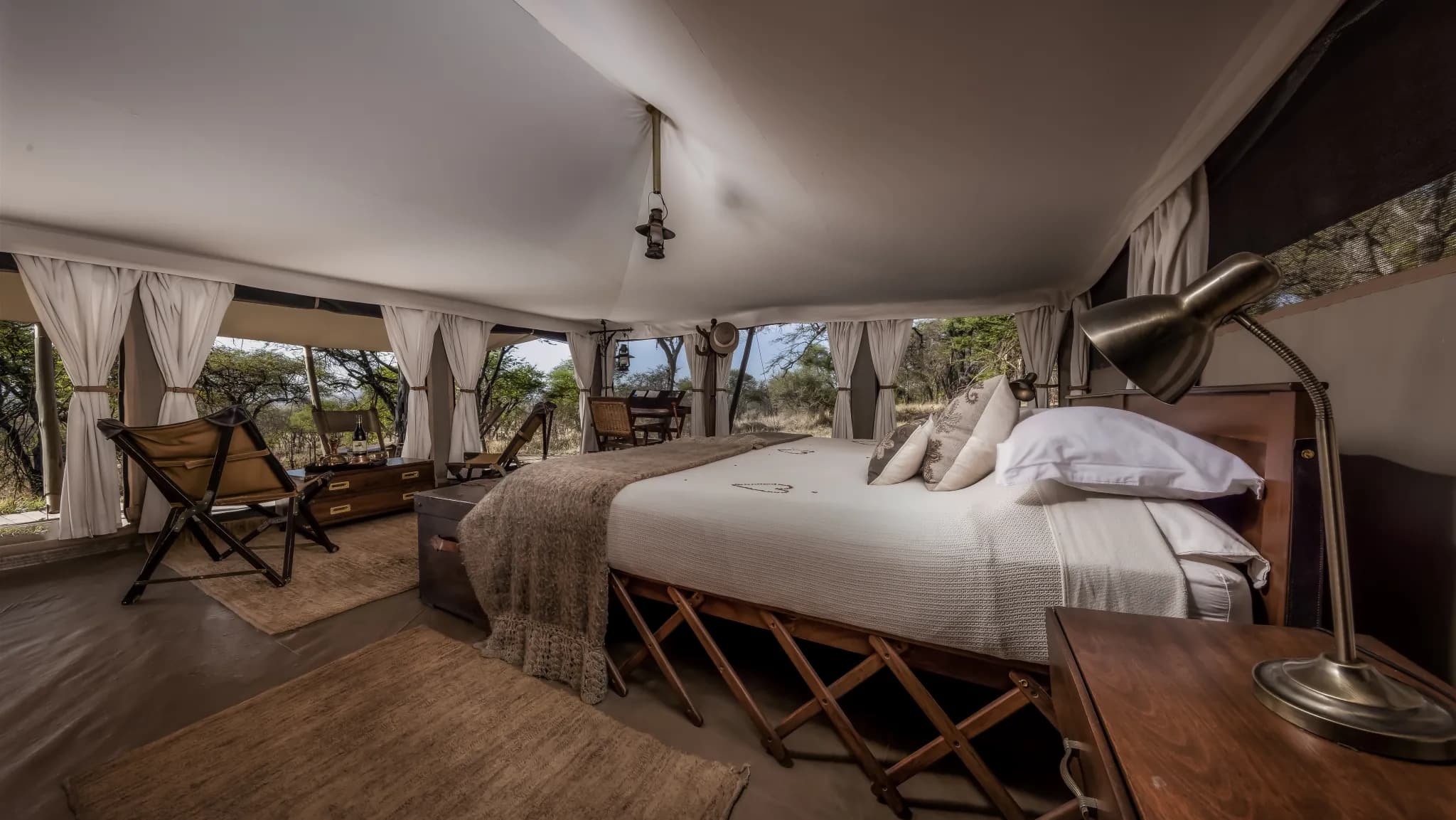 Classic tented interior at Serengeti Pioneer Camp, framed on its southern-plains view — Photo: Elewana Collection
It is also the camp of the beginning. From January to March, the short-grass plains around Pioneer become the largest maternity ward on earth: roughly four hundred thousand wildebeest calves are born here in the space of a few weeks, an annual pulse of new life that draws every predator on the plains to the same address. The calving is less dramatic to the eye than a river crossing, but it is the engine of the whole migration — and it happens, for these months, almost on Pioneer's doorstep.
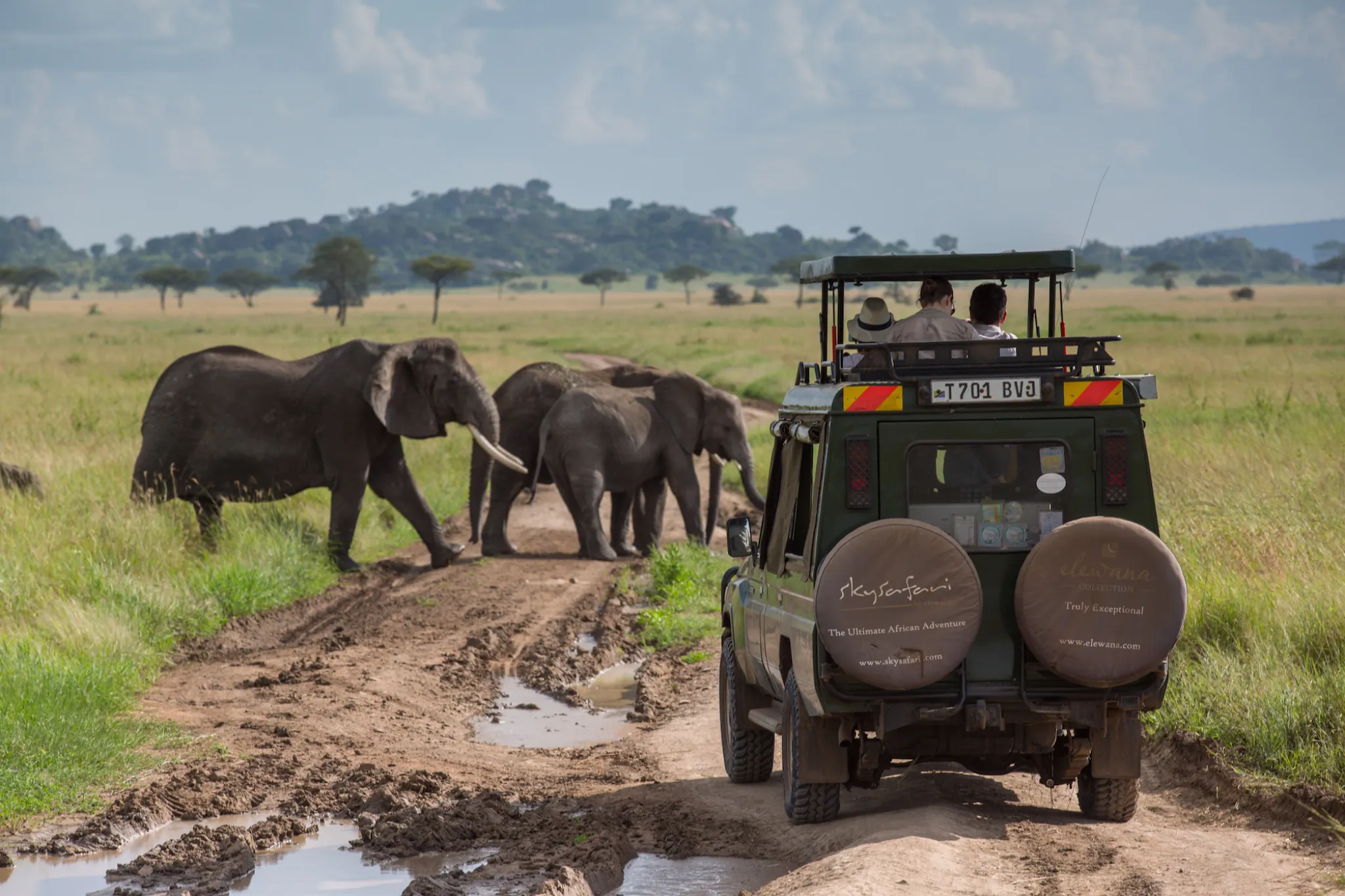 A game-drive vehicle among elephant on the southern plains — Photo: Elewana Collection / Silverless
The location rewards the curious in other seasons too. The kopje boulders carry ancient Maasai rock art; the nearby Moru Kopjes are a celebrated haunt of big cats; and Lake Magadi draws flamingos and makes a fine destination for a sundowner. The camp unofficially supports the Serengeti Cheetah Project, the long-running study of the plains' most fragile predator — a quiet alignment of comfort and conservation that runs through the whole collection.
Migration: The River
If Pioneer is the beginning, Serengeti Migration Camp is the crossing. It stands in the north-central Serengeti on the banks of the Grumeti River — twenty elevated, en-suite tents finished in dark wood and leather, raised above the water on the migration's actual route. The herds pass the camp twice a year, on the way north between April and June and on the way back between late October and December, and in those windows the spectacle arrives rather than being driven to.
The river crossing — wildebeest and zebra plunging through the current — Photo: Elewana Collection / Silverless
The drama of the crossing needs no commentary. Thousands of animals press toward the water, hesitate, then commit in a churning mass of horn and dust and current — the single most concentrated moment in the entire migration. The Grumeti has its own crossings, and the legendary Mara River crossings of the far north lie roughly an hour away by vehicle, close enough to chase on a day trip when the timing is right.
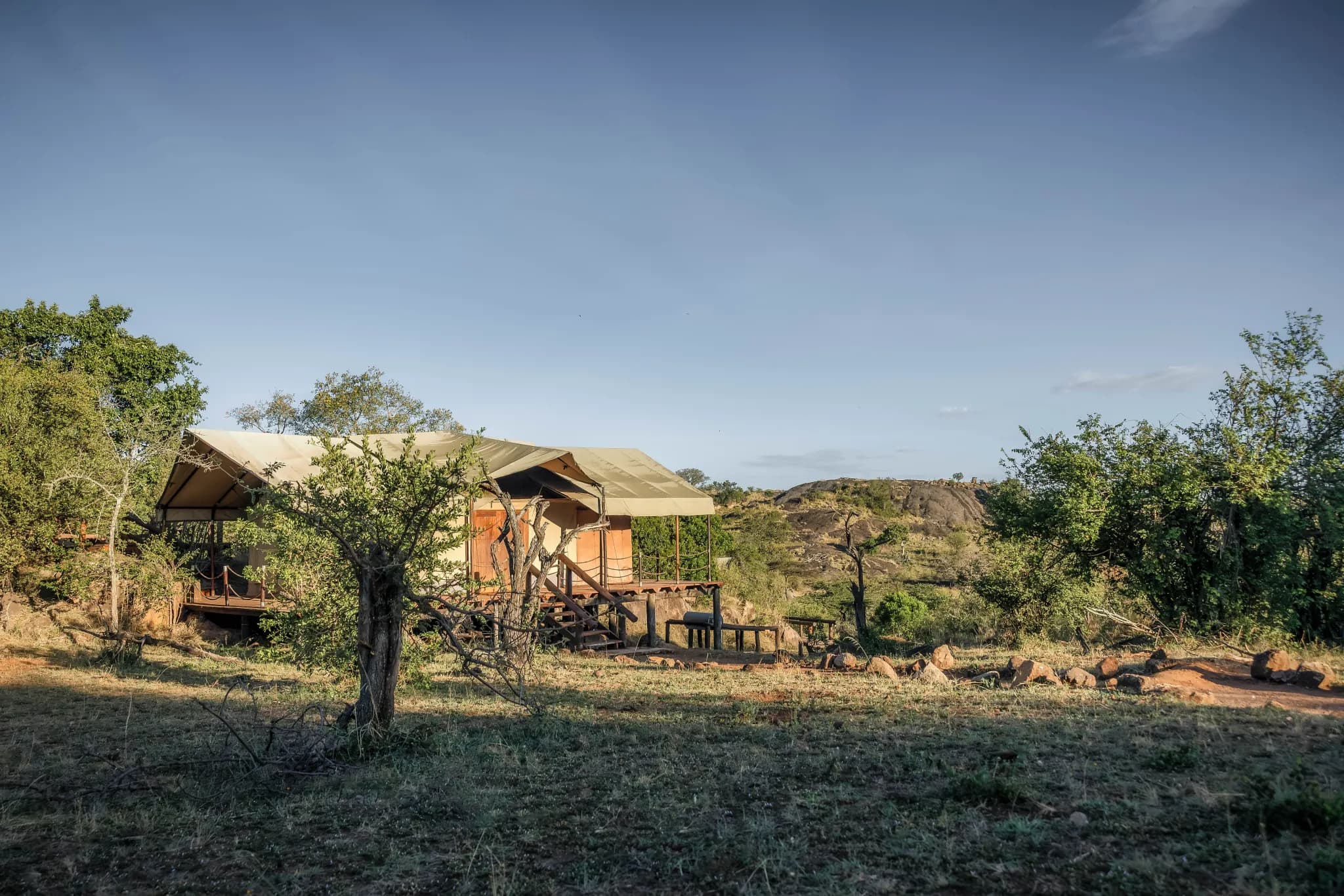 A riverbank tent at Serengeti Migration Camp in the morning light — Photo: Elewana Collection
Back at camp the register quietens. Resident hippos occupy the pools below the tents and can be heard through the canvas at night — a low, conversational grunting that is the truest lullaby the Serengeti offers. There are guided bush walks along the Grumeti, bush meals, a pool, and the particular luxury of an elevated tent that lets you watch the river without leaving your bed.
Explorer: The Amphitheatre
Serengeti Explorer is the newest and largest of the three, and the most architecturally ambitious — a reimagined contemporary lodge set high on the Nyaboro Hills of the south-central Serengeti, with the migration passing directly in front. There are seventy-four keys here, from Savannah Rooms to a Chief's Suite, arranged so that the elevation turns the plains into an amphitheatre and the lodge into its highest tier of seats.
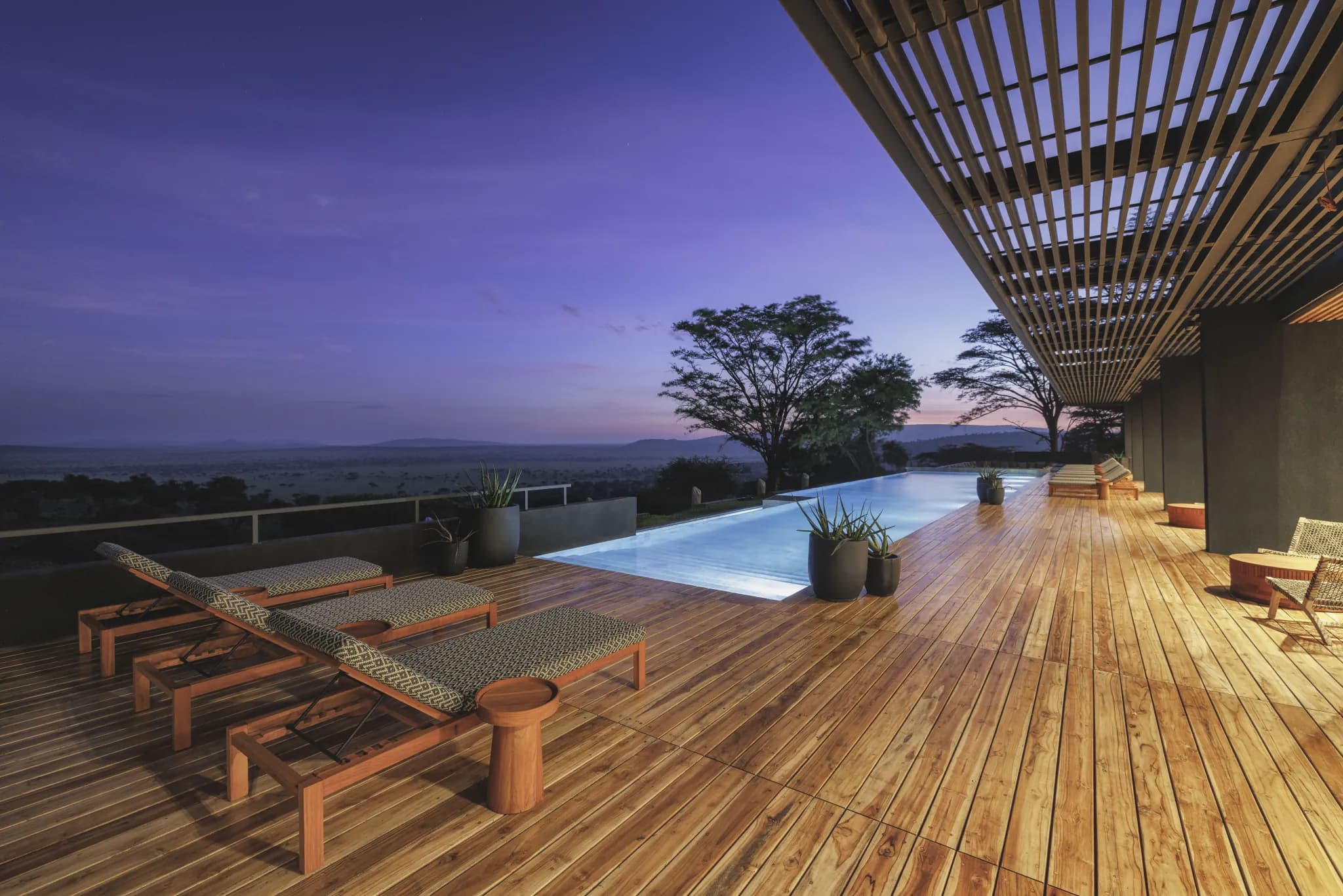 The infinity pool deck at Serengeti Explorer at dusk, looking out over the plains — Photo: Elewana Collection
The thirty-five-metre infinity pool is the signature, a long blade of water set at the edge of the hill with nothing beyond it but the Serengeti. But the more interesting story is in the building itself. Explorer was raised on the footprint of a demolished predecessor, using re-purposed dry-stack stone and local skills, and its interiors are dressed by Shanga — the social enterprise that employs Tanzanians with disabilities to craft from recycled materials. Sustainability here is structural rather than decorative.
The hilltop also makes Explorer a natural base for the wider plains: rhino tracking in the Moru Kopjes, a stargazing telescope, an outdoor cinema, and a five-course wine-paired dinner in the Divai Cellar for those who want their Serengeti with a sommelier.
The Photographic Hide
Explorer's most singular feature is sunk into the ground beside a waterhole. A semi-submerged photographic hide places you at eye level with the surface of the water, looking out across it toward whatever has come to drink — and it is paired with a dedicated photo studio and an in-house photographer.
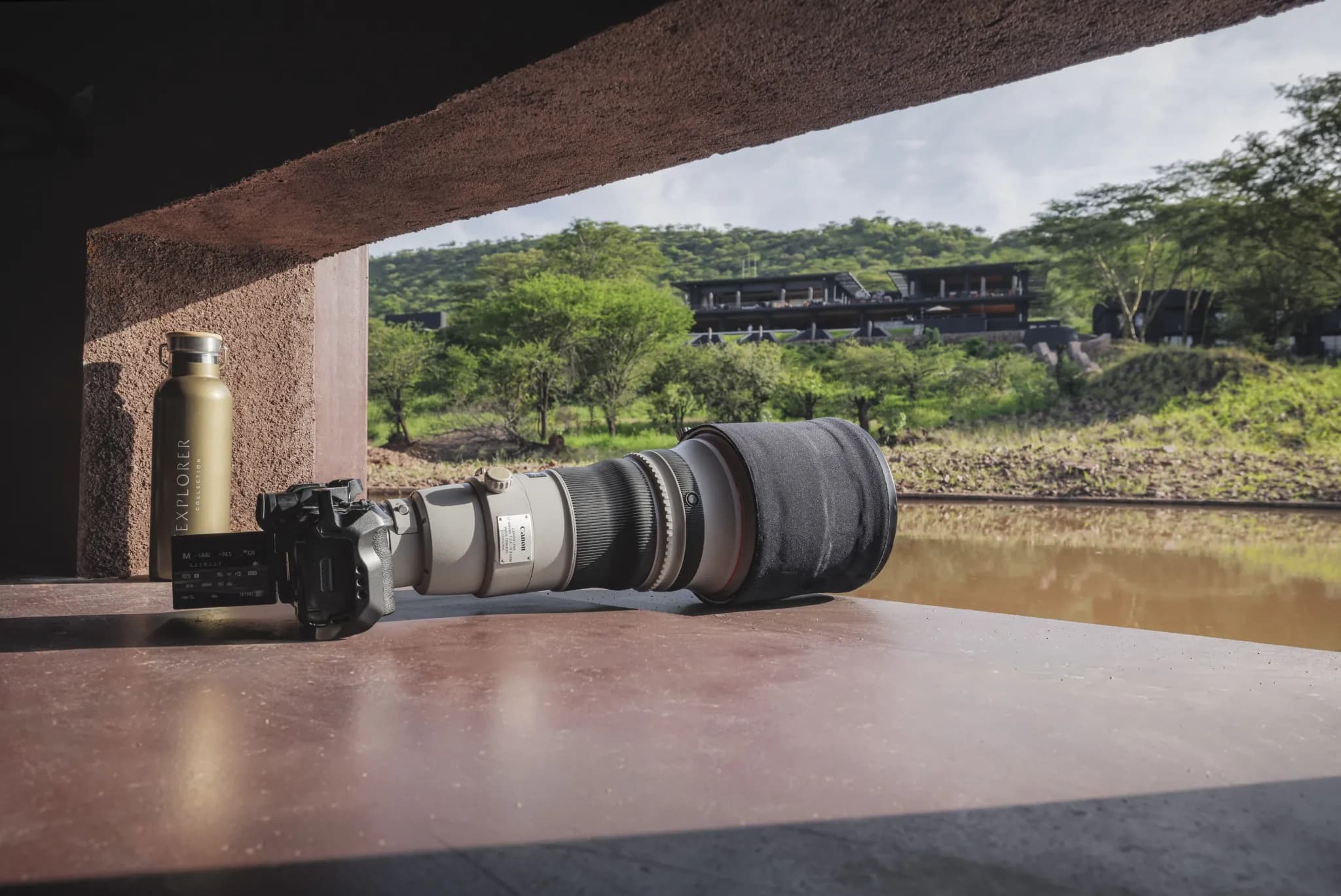 The semi-submerged photographic hide at Serengeti Explorer, a long lens trained across the waterhole toward the lodge — Photo: Elewana Collection
The change in perspective is the whole point. Photographed from a vehicle, an elephant is a subject you look down toward; photographed from the hide, it fills the frame from the waterline up, monumental and close, the light coming flat across the surface in the early morning. Cameras and long lenses can be rented; the in-house photographer is there to help you use them. It is the rare lodge amenity that improves the pictures you take home rather than merely the comfort of taking them.
When to Come
Which leaves the only question that matters. The Serengeti is a year-round destination — the Big Five never leave, and any of the three camps will give you an exceptional safari in any month. But if you have come for the migration, the calendar is the map.
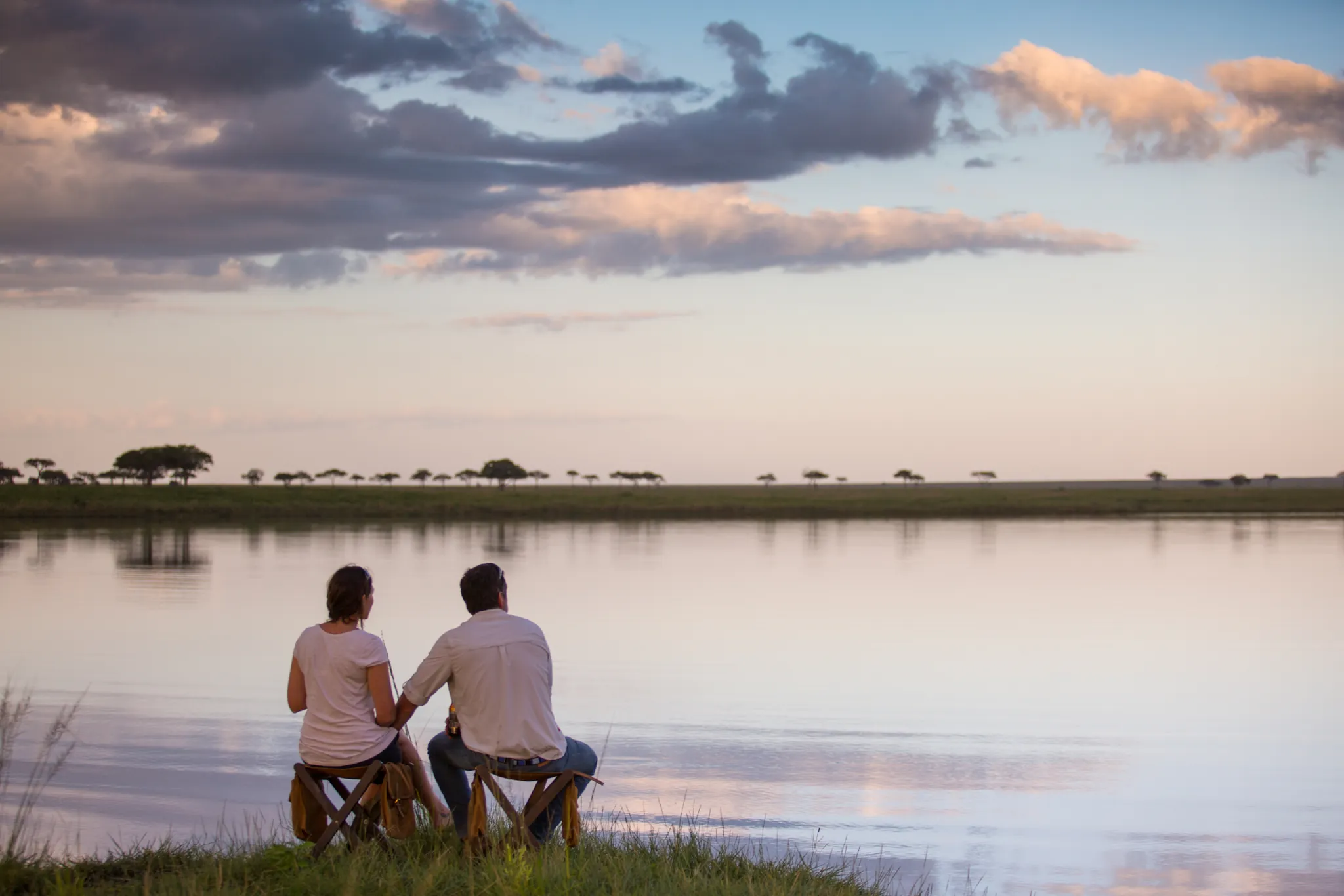 A couple at a Lake Magadi sundowner near Serengeti Pioneer Camp, the plains dissolving into dusk — Photo: Elewana Collection
Come in January to March, and Pioneer puts you in the south for the calving. Come in April to June or late October to December, and Migration Camp puts you on the Grumeti for the crossings. Come for the long central season, and Explorer's amphitheatre lets the herds pass below you. The finest Serengeti itineraries simply follow the herds — beginning at one camp and ending at another, reading the year in order.
Getting Here: All three camps are reached by light aircraft from Arusha, roughly an hour's flight, with a short transfer at the far end. Pioneer connects via Seronera airstrip (about a fifty-minute drive), Migration Camp via Lobo airstrip (about forty minutes), and Explorer via Seronera (about forty-five minutes).
When to Visit: Time the camp to the chapter of the migration you want. Pioneer for the January-to-March calving in the south; Migration Camp for the river crossings in April-to-June and late-October-to-December; Explorer for the central season when the herds pass directly below the hills.
Afrilux9 Verdict: Most Serengeti lodges ask you to gamble on whether the herds will be in front of them. Elewana removes the gamble by arranging three camps along the migration's own circuit and inviting you to choose the season rather than the spot. Pioneer for the beginning, Migration Camp for the crossing, Explorer for the long elevated middle — three rooms in the same vast house, each with the curtain drawn back on a different act. Decide when you are coming, and the Serengeti will tell you where to stay.
Imagery and property information courtesy of The Elewana Collection (@elewanacollection), which retains all rights.
Cover photograph: Elewana Collection
Part of our guide to Tanzania's Northern Circuit.
More from Tanzania's Northern Circuit
The Private Serengeti: Inside Singita Grumeti's 350,000-Acre Kingdom
5 min readThe Silent Serengeti: A Masterclass in Private Expeditions
3 min readA Room in the Baobabs: Tarangire Treetops and the Elephant Capital
7 min readCape-Dutch in the Crater Highlands: The Manor at Ngorongoro
6 min readFrom Tree to Cup: Arusha Coffee Lodge and the Art of the Gateway Night
7 min readThe Gateway Ritual: Gran Meliá Arusha and the Road to the Serengeti
6 min read
Inspired by This Journey?
Search flights and hotels to start planning your own African escape.
Begin Your Journey