A Different Africa Entirely
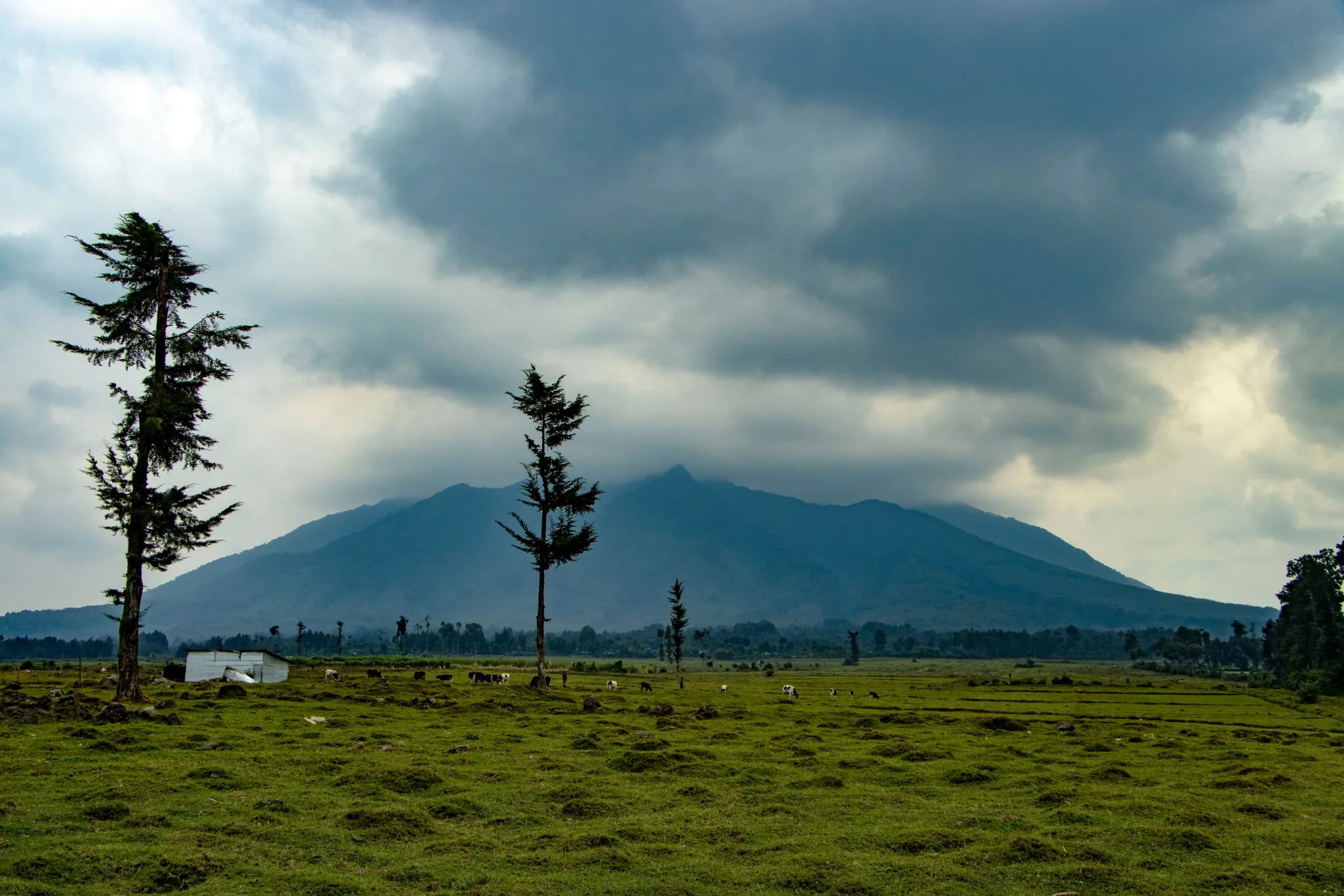
Rwanda undoes most of what a first safari teaches you. There are no plains here and no dust; the light is cool and white rather than gold, filtered through mist and eucalyptus. The country is small, densely farmed and almost entirely upland — every hillside terraced, every valley planted — and the wilderness does not stretch to the horizon. It begins at a line. On one side, potato fields and pyrethrum and the low stone wall that marks the park boundary. On the other, forest, rising steeply into cloud.
That forest is the Rwandan flank of the Virunga massif — a chain of eight volcanoes shared between Rwanda, Uganda and the Democratic Republic of the Congo, five of them within Volcanoes National Park. It is one of only two places on earth where mountain gorillas live, and the reason almost everyone comes. But the shape of the visit is unlike a safari in every practical respect: you walk rather than drive, you are granted one hour rather than a day of open-ended looking, and the encounter is rationed by permit long before you arrive. Understanding that is most of what planning Rwanda consists of.
Gorilla Trekking in the Virungas
The mechanics matter more than the mystique, so take them first. A limited number of gorilla families in the park are habituated to human presence, and each may be visited by no more than eight people a day, for exactly one hour. Permits are sold by the Rwanda Development Board against that daily quota, they are the single largest line in the cost of a Rwandan trip, and in high season they are gone months ahead. Nobody arrives and buys one. The minimum age is fifteen, without exception, which is the detail that most often reshapes a family's plans.
The morning begins in the dark. Trekkers gather at park headquarters at Kinigi to be assigned a family, briefed by the rangers who have been tracking it since the previous evening, and driven to the trailhead the assignment implies — which is why you cannot choose your walk. From there the forest rises through bamboo and old Hagenia woodland, wet underfoot and steep in long stretches, and the trek runs anywhere from forty minutes to five hours depending on where the family has moved overnight. The trackers radio down; the group climbs to meet them.
Then the hour. It is not long and it is not, in the ordinary sense, a wildlife sighting. Mountain gorillas share very nearly all of our DNA, and the effect at close range is less awe than recognition — a silverback registers your arrival, decides you are of no consequence, and returns to eating. The infants tumble. The females browse with a kind of focused economy. Nothing performs. Our own account of what that hour does to a person is in the Singita Kwitonda essay, and it concludes, honestly, that no description is sufficient.
The Second Morning in the Forest
One hour is a long way to travel for one hour, which is the argument for a second permit — and for the golden monkeys. Cercopithecus kandti is endemic to the Albertine Rift, lives in the lower bamboo, and moves in loose troops of dozens at a speed that makes the gorilla trek look contemplative by comparison. The tracking is physically much lighter: shorter distances, gentler ground, a lower altitude band. The encounter is closer to comic than solemn, and it is the better half of the pairing for anyone uncertain about the climb.
Beyond the primates, the Virungas are quietly one of the finest montane birding grounds in Africa — the Albertine Rift endemics are the draw, and a guide who knows them will change what you notice. There is also the walk to Dian Fossey's Karisoke, the research site she established in the saddle between Karisimbi and Bisoke in 1967: a hard, wet three hours up to a clearing that holds her grave and those of the gorillas she studied. It is a pilgrimage rather than an outing, and the people who make it tend to rate it alongside the trek itself.
Where to Stay
Almost every lodge of consequence sits within a short drive of the park gate at Kinigi, which means the choice is less about access than about what you want the evenings to feel like — and, increasingly, about what the property does for the land around it.
Singita Kwitonda stands directly on the park boundary, its suites oriented across farmland toward the forested slopes, with a farm-to-table kitchen drawing on ground within sight of the dining room and a reforestation programme working the acreage between the lodge and the park. Bisate Lodge is built into the eroded cone of an extinct volcano, its domed rooms echoing the shape of the amphitheatre around them, and has planted a very large number of indigenous trees on land that was farmed until recently.
One&Only Gorilla's Nest occupies a mature eucalyptus grove at the foot of the volcanoes — the most conventionally luxurious of the group, and the easiest place to spend a rest day. Sabyinyo Silverback Lodge is the one worth knowing about on principle: it is owned by the community trust that represents the villages around the park, and its profits go back to them rather than to a hospitality group. And Virunga Lodge sits high on a ridge between Lakes Bulera and Ruhondo, further from the gate but with the best view of the chain of any of them.
What the Permit Pays For
Rwanda's permit is expensive by design, and the design is worth understanding before resenting it. High-value, strictly limited tourism is the mechanism by which a small, crowded, intensively farmed country makes a forest worth more standing than cleared. A fixed share of park revenue is returned to the communities along the boundary, funding schools, clinics and water projects in the villages whose fields border the habitat — the people who bear the actual cost of living beside crop-raiding wildlife. The eight-visitor cap and the one-hour rule are not scarcity marketing; they are disease and stress limits for a population of just over a thousand animals.
It has worked, which is the rarest thing about it. The mountain gorilla is the only great ape whose numbers are rising, and it was downlisted from Critically Endangered on the strength of that recovery. Much of the science behind it comes from the Dian Fossey Gorilla Fund, whose researchers have monitored these families continuously for decades and whose campus in Musanze is open to visitors. Going before you trek changes what you see in the forest: the animals stop being a spectacle and become individuals with recorded histories, some of them longer than yours.
Beyond the Volcanoes
Most people give Rwanda three nights and treat it as an add-on. The country will repay a week. Nyungwe, in the south-west, is one of Africa's oldest montane rainforests and holds a dozen or more primate species including habituated chimpanzees, along with a canopy walkway suspended across a ravine. Akagera, on the Tanzanian border, is the savannah counterweight — a park brought back from near-collapse under African Parks management, with lion and black rhino both reintroduced, so Rwanda can now honestly offer the Big Five as well as the gorillas. Lake Kivu supplies the days off: warm, bilharzia-free water, no crocodiles or hippo, and a shoreline road that is one of the best drives in East Africa.
And there is Kigali, which most itineraries reduce to an airport. It is a genuinely pleasant city — clean, safe, walkable in parts, with a coffee culture built on the country's own crop and a small contemporary art scene. The Kigali Genocide Memorial at Gisozi is also here. It documents the 1994 genocide against the Tutsi and it is a difficult morning; we would not describe it as an attraction, and we would not suggest skipping it either. Understanding what this country has come through in three decades is inseparable from understanding why it protects what it protects.
Practical Considerations
GETTING THERE
Kigali International has direct services from several European and Gulf hubs and is among the easiest arrivals on the continent — which is a substantial part of Rwanda's appeal, since no domestic flight is needed. Musanze and the park gate are roughly two to two and a half hours north on good tarmac, through terraced hillsides that are worth staying awake for. Your lodge will arrange the transfer; helicopters are available and mostly unnecessary. Note that permits are tied to named passports, so book them before you book flights, not after.
IDEAL DURATION
Three nights near the park is the working minimum — one to arrive and be briefed, one for the gorillas, one held in reserve, because a trek lost to illness or weather cannot be repeated on a fixed permit. Four nights buys the golden monkeys or Karisoke without making the schedule brittle. A week lets you add Nyungwe or Akagera and a night on Lake Kivu. Rwanda also pairs well as a three-night opening to a longer Kenyan or Tanzanian trip, and the order matters: do the walking first, while your legs are fresh.
WHAT TO PACK
This is the one African trip where the packing list is genuinely load-bearing. Waterproof boots already broken in, gaiters, a proper rain shell, gardening gloves for the nettles and thorns, and long sleeves regardless of temperature. Layers, not lightweight safari clothes — the forest sits high and is cold and wet in any month. A dry bag for the camera. Rwanda has banned single-use plastic bags since 2008 and enforces it at the airport, so leave them at home.
WHEN TO GO
Trekking runs year-round and the forest is wet in every season, so the calendar matters less here than on a savannah safari. The drier windows — roughly June to September and December to February — give firmer ground and easier walking, and they are also when permits disappear first. The long rains from March to May make for harder trekking, lower rates and an emptier park; the gorillas are exactly where they always are.
Activities & Excursions
Everything in the park is permit-controlled and arranged through your lodge, which holds the relationships and the booking calendar. The list below is what a well-built four or five nights actually contains.
THE GORILLA TREK
One family, eight people, one hour. Assigned on the morning, at Kinigi, according to where the trackers found them the night before. Porters are available at the trailhead and hiring one is both a kindness and good sense on the steep sections.
GOLDEN MONKEY TRACKING
A separate permit, a much easier walk, and the obvious second morning. Best taken the day after the gorillas, when you already know the forest and can simply enjoy the chaos.
KARISOKE & THE FOSSEY GRAVE
Three steep, wet hours up to the saddle between Karisimbi and Bisoke, to the clearing where Dian Fossey and the gorillas she studied are buried. No permit lottery, considerable effort, and for many people the most affecting walk in the park.
MOUNT BISOKE
A full day's climb to a crater lake at the summit — genuinely demanding, genuinely rewarding, and the reason to keep your boots dry the day before. Karisimbi, the highest of the chain, is a two-day expedition with a night camped on the mountain.
THE VILLAGES & THE FUND
The community walks around Kinigi and the Dian Fossey Gorilla Fund campus in Musanze are the two excursions that most change how the trek reads — one shows you who lives with these animals, the other shows you who counts them.
Further Reading
Our account of the trek in full, and of the lodge that sits closest to the boundary.
Planning a Trek?
Rwanda runs on permits, and permits run out. Settle the dates first, secure the trek through your chosen lodge, and build the rest of the trip around it — then search flights and stays to bring it within reach.
Begin Your Journey